

The best information we can ever provide investors is the mechanics of how we think about macro conditions over time, rather than what we think about them at any particular time. Consistent with this idea, we present our Macro Mechanics, a series of notes that describe our mechanical understanding of how the economy and markets work. These mechanics form the principles that guide the construction of our systematic investment strategies. We hope sharing these provides a deeper understanding of our approach and ongoing macro conditions.
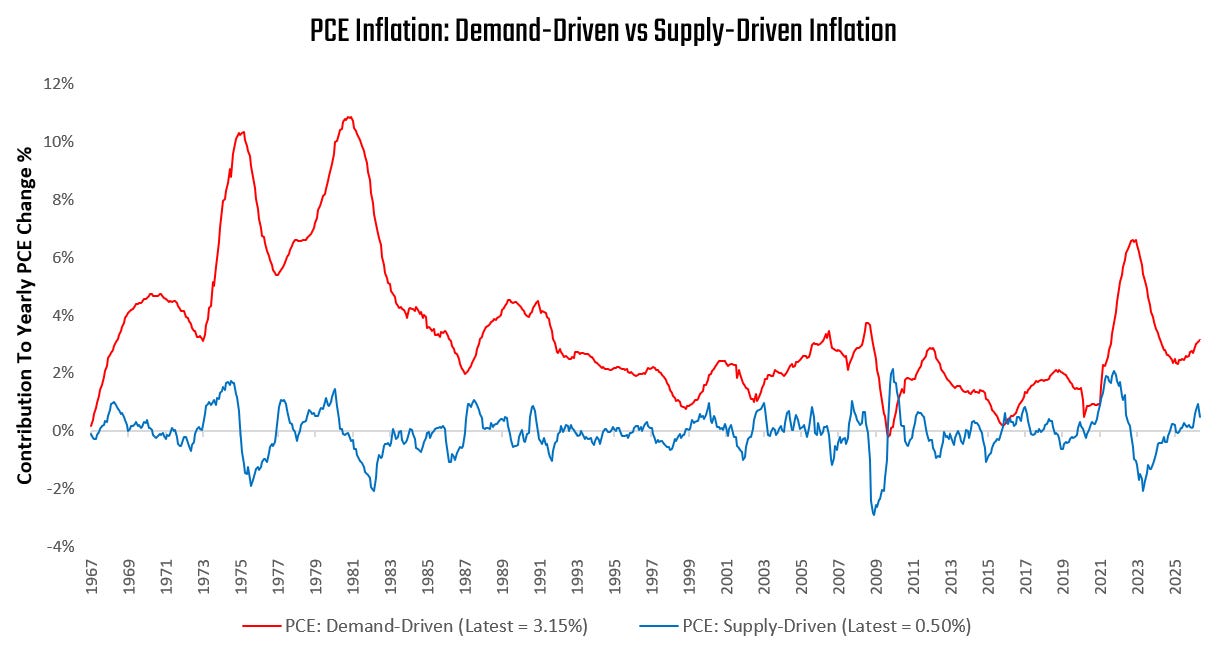
The war in Iran and closure of the Strait of Hormuz have pushed up oil prices across products by approximately 50% this year, with dramatic volatility. This has materialized in significant inflationary pressures across the energy complex, with pressures building in the goods complex as well. This inflationary pressure has driven a material rerating of expectations for monetary policy, weighing dramatically on US Treasuries. As market participants consider the future of inflation and its impact on Treasuries, we think it is important to recognize the principal drivers of inflation and their archetypical paths over the course of an economic cycle:
Demand-Driven Inflation: Inflation is simply the difference between nominal spending and output. Over time, most inflation is determined by how much nominal income an economy generates and spends relative to its existing factors of production. Nominal incomes are driven by a combination of employment, hours worked, and nominal wage rates. While changes in all these variables do have a degree of cyclical variation induced by the business cycle, they are largely stable and consistent over time: employment growth typically follows slow demographic trends, hours worked follow cultural norms, and nominal wages show persistence due to contractual relationships between employees and businesses. Given the relative stability of nominal incomes over time, nominal demand exhibits a similar stability. This stability in nominal demand relative to output leads to stable and consistent demand-driven inflation over time. During business cycle expansions, this demand-driven inflation rises as nominal incomes and spending rise faster than output; and during business cycle downturns, demand-driven inflation falls as nominal activity deteriorates faster than production. Thus, while demand-driven inflation experiences business cycle variation, it exhibits trends that are somewhat predictable and stable, i.e., demand-driven inflation comes in waves.
Supply-Driven Inflation: While demand-driven inflation is a stable phenomenon that comes in waves, supply-driven inflation is less stable. Supply-driven inflation occurs when there is a material shift in the supply of goods, services, or labor relative to existing nominal spending. This supply shift can at times be positive, like the discovery of new natural resource stores or the development of new technology which allows for a dramatic increase in production at the same cost. Alternatively, this supply shift can be negative, with output curtailed due to embargos, natural disasters, or wars. Supply shifts are constantly occurring; however, producers rarely pass on every minor change in supply dynamics to consumers. As such, only material and often unexpected changes make their way to consumers. Said differently, supply-driven inflation comes in shocks.
While demand-driven inflation comes in waves, and supply-driven inflation comes in shocks, these two forces are not independent. Notably, supply-shock-induced inflation can often make its way through the supply chain, exacerbating existing demand-driven inflation. We see this to be the case today, with demand-driven inflation already meaningfully above the Fed’s 2% even prior to the war in Iran. This has material implications for the inflation outlook. Even if war conditions are reversed, the underlying demand forces in the economy will likely continue to sustain inflationary readings well above the Fed’s objectives.
We are in an inflation shock, atop an underlying inflation wave.
Until next time.